Exploring the Pelicans Possibilities of Moving into the Top 10
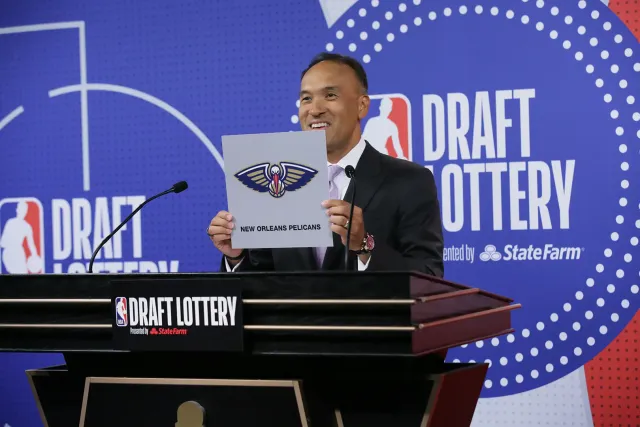
Discussing how the Pelicans get into the lottery & a few prospects to keep in mind.
This past week, Michael Scotto with HoopsHype wrote that the Pelicans have a specific player they’re targeting in the top 10 range of this year’s NBA draft.
The irony is not lost on me.
Whether this is just something the Pelicans front office would love to get done, or a requirement on their summer to-do list, it’s obviously a lofty task.
A few initial thoughts after reading this report:
- If the goal is to compete next year, what’s the purpose of hunting down a pick like this?
- Who in the world is their specific player, especially if it’s a consensus top 10 guy?
- And clearly…
How do they get there?
I’m no trade machine wizard, partially because I can’t bring myself to put some lopsided nonsense together — I might even lean towards the side of making the Pelicans lose a trade.
I’d say up to this point, the front office is winless in trades, so I think it’s a fair assessment.
In the spirit of realism, and because this likely has less than a 5% chance of happening, let’s get straight to it: How can New Orleans actually get into the top 10?
If New Orleans is shooting for the top 10, it’ll be a challenge to find the right team to partner with:
So, who are the teams willing to play ball with Joe Dumars and Troy Weaver — I’ve highlighted teams that’d be open-minded and have assets that align.
Thanks for reading Giddhoops, for all things Pelicans basketball and NBA - subscribe for free to receive new posts and support my work!
This is the lottery order as of today:
- Wizards
- Jazz
- Grizzlies
- Bulls
- Clippers (VIA IND)
- Nets
- Kings
- Hawks (VIA NOP)
- Mavericks
- Bucks
- Warriors
- Thunder (VIA LAC)
- Heat
- Hornets
The likelihood of these teams giving up their pick is low, and I cannot overstate that. If they do entertain offers, the Pelicans have a limited asset pool. Still, they have cards to play.
The cards in question — again, let’s stay on planet Earth here.
The most realistic way the Pelicans land a top-10 pick, or near one, is if they trade Trey Murphy. The only other feasible route I see is moving the 2027 first. Herb Jones could get them into the mid-to-early teens, and Zion might have some appeal (the claim is that he’s here to stay).
Trey Murphy and the best of the 2027 pick are the pieces with the most appeal, but it’s puzzling… because Jake Fischer reported that the ideal return for Murphy would be a player-for-player move, not a slew of draft capital.
That leads me to the dreaded Thunder. Unfortunately, OKC is the only team with draft capital and win-now assets to pull this off.
Meaning this front office is in the deep-end with the most threatening shark of them all — Sam Presti.
Here’s what the anticipated structure of this transaction could be:
Pelicans Acquire (-$2.1M)
- Luguentz Dort (SG) — $17,722,222 (incl. ULTBE, +1 yr, $17,722,222)
- Aaron Wiggins (SG) — $9,887,850 (incl. ULTBE, +3 yr, $24,813,086)
- 2026 1st Round Pick: OKC pick #12
- 2026 1st Round Pick: OKC pick #17
- 2027 1st Round Pick: LAC pick #1–#30
Thunder Acquire (+$2.1M)
- Trey Murphy III (SF) — $25,000,000 (+3 yr, $87,000,000)
- Jordan Hawkins (SG) — $4,741,320 (+1 yr, $7,021,895)
I know this isn’t the top 10, but the teens range is arguably just as strong, especially if you remove the guard play. And if the front office gets desperate, and worries their guy won’t fall to 12 (sorry, not trying to reopen old wounds), then they can pair that pick with 17 to get there.
Dort and Wiggins have some of that win-now type of contribution that aligns with the timeline the Pels currently desire.
Personally, I’m vehemently against trading Trey Murphy, so if it’s not Murph to OKC, the 2027 pick is likely the next most viable plan.
I’ll sum up the subtle complexities of this pick. It is the best of the Pelicans and Bucks pick, and if both land in the top 4, the Pelicans get both picks — if one or both land 5 or lower, the Hawks get the worst of said options.
Clearly, the Bucks would ideally like to get their mega pick back, with Giannis almost 100% on the move this summer, and enter a rebuilding era.
Here’s what I believe the setup could be:
Bucks Acquire (+$4.2M)
- Jordan Poole (SG) — $31,848,215 (incl. ULTBE, +1 yr, $34,044,642)
- 2027 1st Round Pick: NOP pick #1–#30
Pelicans Acquire (-$4.2M)
- Myles Turner (C) — $25,318,251 (+3 yr, $83,550,231)
- AJ Green (SG) — $2,301,587 (+4 yr, $45,000,000)
- 2026 1st Round Pick: MIL pick #10
It’s roulette-spin odds, but trading the 2027 pick could mean giving up two top-4 picks, and that is haunting. Trading this juiced first would add another gamble to this front office’s long list of “HIT ME.”
The assets behind it are interesting. Bucks get a 2027 expiring contract and their pick back. At the same time, the Pels get their hybrid 5-man that can conceal Zion and Queen’s weaknesses, though defensive rebounding remains a major issue. Additionally, AJ Green would be an ideal addition to the Pelicans’ woeful spacing.
And if the Bucks/Pels don’t land high in the lottery, and the best available pick ends up being in the 5-8 range, I might even prefer pick 10 from this class.
And the third and final, tradeable asset that could return a lottery-level asset, which I’d also be unwilling to move if the goal is winning in 2026-27, is Herb Jones.
The Hornets, whose timeline has accelerated following their success this past year, could be eyeing a high-level defender like Jones. I could see the framework looking something like this:
Hornets Acquire (+$0.3M)
- Herb Jones (SF) — $13,937,574 (+4 yr, $82,479,678)
Pelicans Acquire (-$0.3M)
- Grant Williams (PF) — $13,645,500 (+1 yr, $14,265,750)
- 2026 1st Round Pick: CHA pick #14
Grant Williams will be an expiring free agent next summer and is a solid rotation piece for a team that could use veteran presence and depth.
I won’t go trade-machine crazy; I’ll leave the mock deals at those three.
All that said, I likely wouldn’t do any of these deals if the goal is to compete next season.
If it isn’t retooling, as much as I love Murphy and Jones, they’d be shopped for as much draft capital as virtually possible, and Zion would be moved for future assets as well.
I’d, of course, be misaligned with the front office’s agenda, but what’s new? Still, if trading into or around the top 10 happens, the most important question is this…
Who could they be eyeing?
Because New Orleans has struggled in the front court, I think the Michigan trio — Johnson Jr., Mara, and Lendeborg — is worth discussing most, given Troy Weaver’s likely profiles and draft history. I run this, so yeah, I’m calling the shots.
Morez Johnson Jr.
At 6’9 barefoot, Morez Johnson Jr doesn’t scream prototypical 5; however, weighing 250, measuring a 7’3.5 wingspan, and moving the way he does while being as strong as he is…
GREAT NBA player, almost without question, his defensive capabilities will translate adequately as a pro.
That’s Johnson’s appeal; his defensive versatility and athleticism allow him to be a real mover and shaker for any team looking to raise their level on that end.
A high-motor, energy big man who finds a way to tangibly and intangibly impact the game — sold!
Playing alongside Aday Mara and Yaxel Lendeborg put Johnson in a strange defensive spot; yet he proved this past year at Michigan that he’s incredibly malleable to different roles.
Some could even say that, though Mara left a bigger analytical mark, Morez Johnson was their most important defender — high praise, considering the historical level of the Wolverines team.
The tape absolutely jumps off the screen. Johnson can hold his own at the point of attack, guard 3-5, execute switches effectively, and cover a ton of floor with his range.
This archetype would be maximized in Jamahl Mosley’s schemes and can shore up Morez’s technical issues. Mosley made similar work to that of Wendell Carter, who just so happens to measure and weigh similarly to Johnson. Though Carter was a more proficient shot-blocker in college, their shared strength and verticality are enough to draw the comparison.
It shocked me to see he’s on the lower end of the stock for NBA prospects, which has me anticipating that he’s a high stop% player in the NBA who doesn’t swing games with turnover impact but rather has more sustainable defensive play.
On the other end, the freaky athleticism and motor allow him to be a top-of-the-line play-finisher and offensive rebounder. The metrics are ten toes down with the tape in this regard, too.
His freshman year at Illinois, he was a 96th-percentile offensive rebounder, and at Michigan, he was at the 86th percentile (and likely higher if Michigan wasn’t so huge and talented).
I think slotting Morez Johnson next to Zion or Queen wouldn’t be a permanent solution by any means at the 5, but would easily be a strong defensive problem-solver for a team that needs one.
His game is easily scalable to the postseason, and in the next 3 years or so, I’m almost sure we’ll be witnessing it.
- Weaver scale - 9.5/10, literally a beef stew clone
- Giddhoops scale - 9/10
Aday Mara
The Pelicans have gone years without a skyscraper-type center, and as the old hoops adage goes, “You can’t teach height.”
Aday Mara could be the first guy to end the dry spell, and he solves several problems for New Orleans at once.
Players such as Zach Edey, Donovan Clingan, Walker Kessler, and rookie Ryan Kalkbrenner have become impactful NBA players simply because of their size.
Mara fits this bill. Towering over almost the entire NBA at 7’3 with a stupid-long 7’7 wingspan, he has a frame that makes rim protection an elite skill and should make him immediately impactful.
Mara was phenomenal in his time at Michigan this season, anchoring a National Championship defense with effortless shot-blocking, solid timing, and encouraging range, even with some slow-footedness and second-jump concerns.
There are slight concerns about his habits, given that he’s average among contesters in terms of fouls per possession. The film shows how much he accomplishes in drop coverage, how well he plays at that level, and how he tracks quick guards despite looking Galute-esque at times.
With Mara as the backline defender for the Pels, their 23rd-ranked defense could effortlessly move up the ladder. His shot suppression would do wonders for them. He ranks:
- 4th in NCAA with a block % of 12
- 2nd in NCAA with a defensive box plus minus of 5.3
- 83rd percentile in the stocks-to-foul ratio.
- 100th percentile in RAPM rim deterrence.
… to name a few.
It’s not all perfection.
Ideally, you would’ve liked him to show up more in the possession game, like Edey, who has been immensely impactful, using his rebounding to maximize shot attempts for his team while keeping opponents’ second-chances to a minimum.
Mara’s remained a slightly above-average rebounder on both sides of the ball throughout his college career… something the Pelicans need miserably. I’d venture to say he’ll be a quality rebounder in the league; the numbers may have been hindered more so by his supporting cast of surreal size at UM, taking much of the rebounding responsibility off his shoulders.
Mara also provides a substantial offensive game, with a surprising skill set as a passer — he ranked in the 95th percentile in CBB for rim assists, averaging 3.2 per game.
This isn’t a particularly high need for the Pelicans, considering how special Derik Queen is as a playmaker. Yet, it doesn’t hurt to have such encouraging feel and offensive upside from an already high-level defensive prospect.
Mara’s ability to make great reads out of the short-roll and post is a pro skill that accentuates his impeccable feel. I could definitely see him making Zion a play-finisher on wrapped 45 cuts and dunker spot dump-offs.
Regardless, offensively, Mara’s scoring and finishing around the restricted area are immaculate and will remain so because his size remains an outlier at the pro level.
A mega-big man who quietly takes care of the rim while making plays as a rim-roller and post-operator. His Draftable outcome neighborhood supports the potential and aligns with stars like Joel Embiid, JJJ, AD, Chet, Walker Kessler, and KAT, matching his statistical profile.
Overall, Mara should go in the 6-10 range in this draft. Even if the Pels get there, they’re probably in search of a hybrid big while Mara is more of a quintessential modern 5-man.
To me, Mara’s impact was so grand in college and so likely in the NBA that he’ll be almost a non-negotiable pick.
He’s a giant, and so much comes with that: how nimble he is and the feel he presents make it hard for him to fail in the NBA, even more than to sustain success.
- Weaver scale - 3/10
- Giddhoops scale - 9.5/10 — too tall to fail.
Yaxel Lendeborg
Albeit, not necessarily a frontcourt answer — Yaxel Lendeborg’s big-time season has draft nerds looking the opposite direction on his age (23).
And though I’m not as high as some, I’m looking the other way, too.
Reason being, there isn’t really one specific facet of the game Yaxel struggles in — he’s the ideal utility player for win-now teams. The only issue people have with his game is that his on-ball creator ability caps his ceiling.
That feels like a moot point to me, because no smart team will be relying heavily on him as a second-side creator.
He’s Mr. Ancillar. The jack-of-all-trades type of game makes him so enticing to teams seeking immediate value.
Yaxel imposes his will defensively like Johnson, but his range in assignments probably stretches closer to 2s and 3s than to 5s like Johnson.
Yaxel is statistically more of a defensive playmaker, generating more stocks altogether.
It feels almost like lazy scouting to write him off because of his age, especially considering he didn’t pick up basketball until he was 15 and that his rate of improvement as a collegiate athlete has been rapid.
Seriously, it’s far more difficult to find flaws in his game than anything else.
- He was in the 100th percentile for A/TO ratio with 3.1
- Shot 37.2% from three on 8.6 attempts per 100 possessions
- Efficient in almost every play type, especially in off-ball at the rim plays —an elite athlete who shot 72.9% there.
- Had an incredibly low turnover rate, 98th percentile creation TOV rate.
- Solid rebounder, 76th percentile DREB at UAB, 65th percentile OREB at Michigan, and 75th percentile at UAB.
If the Thunder find a way to get their grimy paws on Lendeborg, that’ll be trouble for a team that has slight issues that the 23-year-old college phenom could tackle right away.
That fits with a win-now scheme, technically agrees with what Joe Dumars desperately wants to do — though I believe the less responsibility he has in the NBA, the better he’ll be.
That sentiment doesn’t feel ideal for the Pelicans, who will be asking a ton out of whoever they acquire.
- Weaver scale - 9/10
- Giddhoops scale - 8.5/10
There are more prospects that I’d prefer in a trade up situation, and will definitely be writing about in my next piece.
Dailyn Swain, Brayden Burries, Keaton Wagler, Labaron Philon, and Allen Graves are a few to mention.
Plus Chris Cenac Jr., whom I’m lower on but is rumored to be a potential Weaver guy.
Let me know in the comments below who you want to read about in the next piece, who you feel the Pelicans front office is targeting, and who you’d be targeting!
A quick share helps us a lot!