Pelicans Head Coaching Search Manifesto
Part one of breaking down all Pelicans Head Coaching Candidates
The Pelicans approach a pivotal offseason.
Despite lacking a first-round pick and coming off a turbulent year, this offseason represents a ‘clean slate.’
That’s at the very least what Joe Dumars and Troy Weaver are claiming, as they’ve cleared out what remains of the David Griffin to the point where not even the carcass remains.
Many moves would contradict that entirely, and they were perfectly in control of getting out on the right foot in the summer of 2025.
Now is not the time to go there, and quite frankly, I’m tired of doing so, but each senseless move gives me no choice.
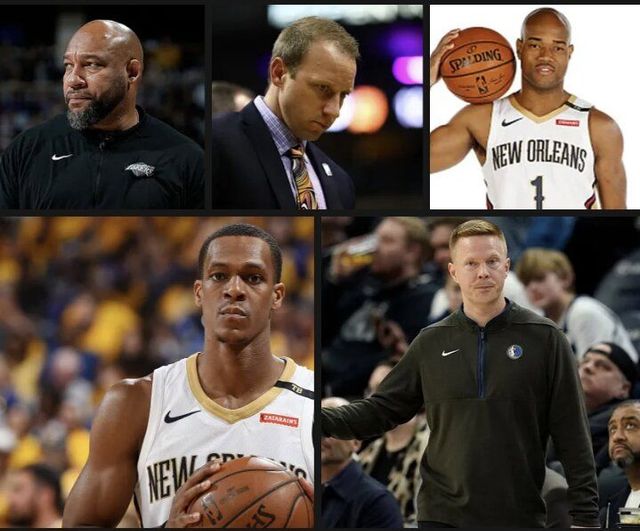
Marc Stein and Jake Fischer reported that the five names swirling around the Pelicans’ head coaching vacancy:
- Darvin Ham- Milwaukee Bucks
- Rajon Rondo - Milwaukee Bucks
- Steve Hetzel- Brooklyn Nets
- Sean Sweeney- San Antonio Spurs
- Jarrett Jack- Detroit Pistons
And on Monday, it was confirmed that interviews have already been conducted for Rondo, Ham, and Wetzel.
A lot of names, many different, and all but Rondo have a tie to either Dumars or Weaver.
I personally have about as little faith in the leadership for a myriad of reasons.
But, Jake Madison with Locked On Pelicans made an excellent point on Monday in his podcast that I want to echo: it’s encouraging to see the front office currently casting a wider net in its search for a head coach.
Notably, when you consider the fact that the way this front office was attained wasn’t more like fishing in a pet tank.
If all of these names are being formally considered and interviewed this week, who makes the most sense for New Orleans, and based on what… so without further ado, let’s get to all these names!
Rajon Rondo
Without a doubt, the name that pops more than anyone else’s on the potential candidate’s list.
Rajon Rondo is the coach most of the fan base is clamoring for, and it’s hard to blame them for it.
Rondo is described by so many of his teammates as the smartest player they have ever played with, and his basketball intellect shone throughout his 16 years in the NBA.
There is no question Rajon Rondo can think the game of basketball at the highest level.
Does that alone make him capable of being the next coach of the Pelicans?
It’s certainly worth considering, because without a doubt, Rondo’s championship pedigree, extensive tenure in the NBA, and his game expertise would immediately win over the locker room and earn the players’ respect.
I also believe that Rondo is qualified to leave a serious footprint on the development of Jeremiah Fears and Derik Queen.
Year one might come with some hiccups and bruises.
He may struggle to manage games with specific lineups, and he will need a quality support system of veteran assistants to guide him through taking on the on-court chief role.
Are the Pelicans capable of getting him the support structure he needs? How analytics-focused is he? Is he a better fit to lead player development and take a high-level assistant role? Can that even happen with the Pels? Will his perfectionist basketball brain explode when players aren’t executing as they should? (That’s a half-serious question.)
What isn’t up for question is Rondo’s ability to see multiple moves ahead. This may be the most intriguing aspect of his coaching potential, especially given how the Pelicans performed in the clutch this year.
With Rondo at the helm, I’m confident he can truly orchestrate the end of games from the sideline, as he did on the court.
These intangible moments he brought to winning were somehow overlooked over his career, like this incredible crunch-time quarterbacking
Yet, sometimes that ability doesn’t always translate, i.e., Steve Nash.
At the same time, we’ve seen former players evolve into incredible coaches in the modern era, such as Jason Kidd and JJ Reddick.
JJ Reddick jumped right into coaching and established himself as one of the better coaches in the league with no prior experience, arguably less so than Rondo, and under a larger spotlight.
Rajon Rondo will get his opportunity to be an NBA coach. He’s extremely passionate about the X’s and O’s.
Back in the 2017 playoffs with the Chicago Bulls, his major aim in the series was to outcoach Celtics coach Brad Stevens from the hardwood.
The spark for coaching has always been there. Rondo has an innate game feel and will be a coach that players will follow out of respect for his career — the ceiling for him as the lead man is incredibly high, nevertheless…
The question begs itself: If the Pelicans’ current situation were a restaurant menu, would it be the Cheesecake Factory, with too much going on? With Rondo’s experience as a coach, does that make him the overwhelmed orderer who can’t handle so much at once?
Even if Rondo could be a fantastic coach for the foreseeable future, it remains uncertain if his time with the Pelicans is right now.
Darvin Ham
The idea of Darvin Ham is nice: a former NBA journeyman who can earn the players’ respect. The idea of world peace is nice, too, but only a fool would believe it could come to fruition.
Jokes aside, a major reason the Lakers brought him on was that of a player’s coach who can manage personalities, be hard-nosed, and create an environment that pros want to be a part of.
After a successful first season, where Ham and LA won two playoff series before getting swept in the WCF, it seems as though the head coach could serve out all four years of his contract.
Then the lineup debacle happened, or maybe we should call it the Lakers’ version of the film Groundhog Day.
If you’re unfamiliar, here’s the quick synopsis:
The Lakers went to the WCF the year prior with the starting lineup of D’Angelo Russel, Austin Reaves, LeBron, Jared Vanderbilt, and Anthony Davis.
The lineup was successful in the playoffs and meshed well, with Dennis Schroder and Rui Hachimura coming off the bench.
The very next year, with a slight turnaround, Ham took that successful lineup and, indecisively, played mix-and-match with Taurean Prince and Cam Reddish in the starting lineup all season.
A team in the conference finals the year prior played 28 different starting lineups — all while being almost fully healthy with the exception of Vanderbilt.
He even went so far as to play the death-by-power-forward lineup of Cam Reddish, Jared Vanderbilt, Taurean Prince, LeBron, and Anthony Davis. All while D-Lo, Reaves, and Hachimura came off the bench.
Ham’s constant wavering caused locker-room dissension and hindered synergy, all while lacking offensive vision.
Zach Lowe and other analysts would discuss how little consistency you’d see in the Lakers’ halfcourt actions — finding something that worked, only for it to evaporate from the scheme for weeks after.
Ham is in this conversation because of his ties to this front office, a normal NBA concept for any organization, but special to Pels fans, as it gives us all PTSD.3
Mind you, Ham played (kinda, 5 minutes a game) on the 2004 Championship Pistons team that Joe Dumars constructed, and I was a firsthand witness to Troy Weaver and Darvin Ham rubbing elbows during shootaround of the Pels home game versus the Bucks.4
It’s fair to say Ham is a more defensive-minded coach, something I think the Pelicans need intense focus on, and he’s proven he can boost his team’s rating on that end to some degree.
Nevertheless, there are unquestionably better defensive-minded coaches, and I’ve seen some horrible decisions on PnR coverages in his time with LA in the postseason.
If Ham doesn’t get the Pelicans job, I don’t know how likely it is that he interviews for other HC openings — Doc Rivers has advocated for Ham since his Laker days… but maybe in 2026, Rivers being your biggest advocate isn’t the best of signs.
I don’t believe Ham is the right man for the job. I’ve been wrong before, and I won’t act like I know everything about Ham as a coach; however, his coaching the Lakers to the WCF in 23’ doesn’t mean much to me, given the talent of that team.
Furthermore, the lineup disasters are especially worrisome because the Pelicans roster, of uniquely scattered talent, needs a careful craftsman.
You never know! At the very least, the Pels could be a contender with Ham… for the NBA Cup!
Steve Hetzel
Speaking of higher-quality, defensive-minded coaches, the current lead assistant for the Brooklyn Nets, Steve Hetzel, also conducted an interview with the Pelicans on Monday, according to Will Guillory.
Opposed to Rondo (for excitement) and Ham (pure fear), Hetzel is an under-the-radar option known for his steady climb through the NBA coaching ranks.
He has 4 years under his belt as a video coordinator from 2005-09, 1 year under Greg Popovich in SA, and 3 years under Mike Brown with Cleveland.
From there, Hetzel was the player development coach for the Detroit Pistons (when Joe Dumars was still in the role of basketball ops president) from 2009-2013.
After that, Hetzel has worked as a D-League and Summer League Head Coach, and an assistant with Charlotte, Portland, Orlando, and Brooklyn.
It isn’t an indictment on Hetzel that he’s never been hired to be any team’s Head Coach; in fact, he’s interviewed for openings before — most recently the Suns job from last summer that Jordan Ott ended up winning.
Here’s what to know with Steve Hetzel:
He is touted around the league as a high-quality player development guy, excelling at bringing along young talent and maximizing their skill sets and growth.
He is a hard-nosed, gritty type of coach — something he picked up under Tom Izzo’s wing before he got his break in the NBA.
Defense is his area of expertise with an emphasis on disruption, toughness, forcing turnovers, and overall grit.
He and Jordi Fernandez have created great defensive prowess on young, tanking teams — I’m sure there is give and take as far as who deserves credit for that, but I’m positive Hetzel has learned tons from an elite coach in Fernandez as his right-hand man.
Now, there’s a whole lot of ambiguity with the impact of coaching in the NBA — it’s incredibly evident with the elite coaches such as Joe Mazzulla, Eric Spoelstra, Rick Carlisle, and Chris Finch.
They also get the opportunity to prove it in the postseason, when coaching comes alive with a back-and-forth of adjustments and dynamic gambits.
With all that to say, without seeing firsthand what Hetzel’s doing in practices, it’s hard to quantify what he’s capable of as a head coach (same as Rondo) and what he’ll implement.
My best judgment is that he’s capable of being a phenomenal, defensive-minded leader who can put the Pelicans’ young talent in advantageous situations while doing a solid job of developing them.
Until we watch him handle an 82-game season of rotations, late-game management, body language/response from the players, and most importantly, what he introduces schematically in a training camp, we can only glean so much from Hetzel’s NBA journey and what that means for him.
As far as team fit goes, is a first-time coach known for his player development the right fit for the Pelicans, and is he the type of coach who aligns with Joe Dumars’s desire to win now?
Will his gritty nature be well-received and amplify Zion Williamson’s abilities, or be aggravating to him? We know the rumors surrounding his camp’s concerns regarding Stan Van Gundy, one of the most intense coaches in recent history.
Sean Sweeney
Darvin Ham is the base evolution of a defensive coach; Steve Hetzel is a level above him; and Sean Sweeney might be the pinnacle of defensive-centric minds among these three candidates.
Sweeney is another coach who has bounced around the league as an assistant, making his biggest impact as the de facto defensive coordinator during his time under Jason Kidd, first with the Milwaukee Bucks from 2014-17 and then with the Dallas Mavericks from 2021-25.
Jason Kidd gave Sweeney the keys to the defense in both stints, and it paid dividends for their squad’s defensive rating — with leaps from dead last in 2014 to third in 2015 with the Bucks and from 21st in 2021 to 7th in 2022 with the Mavs.
Sweeney is doing it all over again with the Spurs this season, which is why he has yet to interview for the opening: he’s too busy swinging playoff games as his defensive virtuoso.
The Spurs this year, 25th last year, to third this year — and yes, they do have Wemby, but Sweeney maximized Wemby’s impact.
Pre-Sweeney, 2024-25, to this season, the Spurs are 5 points better in defensive rating with Wemby on the floor, and 6 points better with Wemby off the floor.
It’s not a with-or-without Wemby thing either; Sweeney has raised the impact of each individual on that end of the floor.
Spur’s Defensive EPM increases 2024-25 to 2025-26:
- Stephon Castle: -0.8 to +1.1
- Devin Vassell: -0.9 to +0.5
- Keldon Johnson: -1.7 to -0.2
- De’Aaron Fox: -0.6 to +0.6
Sweeney instills successful defensive tendencies and schemes into his teams & players, and the numbers support that claim.
My favorite part of Sweeney’s presence is the way he carries it out, a way that I think the Pelicans need an immense amount of help with.
One of my biggest pet peeves of the Pelicans this season was the purposeless switching through actions, watching them default to lazily handing their man off to another with no rhyme or reason.
Sweeney would eradicate that habit almost instantaneously.
I watched the Spurs blow up actions all year with their effective dribble hand-off coverages, play the gaps incredibly well, and rotate on a string.
Sweeney played a bigger part in Giannis’ development, and was the Greek Freak’s go-to training partner up until 2021 — a pleasant thing to hear as I’ve noted with the importance of Fears and Queen’s growth.
Player development is awesome, and it’s a priority for a younger New Orleans core.
But the defensive identity and imprint Sweeney could have on the Pelicans is an enthralling concept and would coincide with the “toughness” Joe Dumars wants to establish as the Pels’ calling card.
The Pelicans ranked 23rd in defense this season, struggling to guard actions and giving up a high-quality shot. Sweeney can address this better than any other candidate, in my opinion.
Even more of a concern, but less of a coaching and more of a personnel issue — the Pelicans were a horrific defensive rebounding team, finishing in the bottom three this season.
As were the 2024-25 Spurs, who just so happened to finish top three this season under Sweeney’s philosophies.
Having an offensive guru would be super exciting, and don’t get me wrong — there is a need there too… still, the Pelicans could carry on their high-paced identity on offense in a superior way if they’re able to finish possessions and turn teams over at a higher rate.
Sean Sweeney is that guy; he’s left his mark at every stop in his career thus far, and he can do the exact same for the Pelicans.
Jarrett Jack
As a blend of the aforementioned candidates in terms of qualities, Jarrett Jack poses as an interesting candidate for the Pels vacancy.
Jack is a former player who spent 13 years in the NBA as a respected role player. In a similar manner to how Rondo commanded respect in the locker room, Jack would do the same, given how long he lasted in the league and how he built a respectable career as an NBA journeyman.
To a lesser degree, just as Sweeney and Hetzel, Jack has put in time as an assistant coach with his start in 2021 with the Suns, and from 2023 on with the Pistons, where he made the connection to Pel’s GM Troy Weaver.
Along with ties to current leadership, Jack has connections to New Orleans basketball dating back to 2011 and 2012 — even a quick two-game return in 2016, when he was brought in to back up Chris Paul and was forced to fill his shoes at some capacity when Paul was traded to the Clippers.
Jack has built a rapport with existing and new figures on Airline Highway, and though for the life of me I cannot find any info on his coaching style — which is, like I said, ambiguous as is… It’s worth noting his passion for the game and how he has a mix of traits that most of these candidates possess.
As a role player, it’s hard to have more than a cup of coffee in the NBA — it requires being a smart and winning player.
Jack never averaged less than 20 minutes a game at each stop along his journey, which speaks to that.
Player development was the heftier part of his responsibilities when he was first hired by the Pistons, and what isn’t ambiguous is Jack’s hand in the development of Cade Cunningham — though from my research it seems that Cunningham respects Jack and is a better pro because of him.
The former point guard could be the right man for the role, though some of those same questions and concerns I posed regarding Rondo I pose with Jack.
Even though Jack has been an assistant and been part of a few staffs in comparison to Rondo, the Pelicans’ current situation presents a steep hill for someone like him to climb.
As much as I love beautiful offense, and I really appreciated what James Borrego did with the shot-quality, possession battle, and pace — with so little available to him, like no training camp, almost zero practices, and a strange blend of talent.
The most important aspect of this coaching search is not necessarily finding the most qualified coach.
News flash: This is the New Orleans Pelicans; no renowned, uber-revered candidates are walking through that door.
It’s about finding the coach who fits the absolute best; one who can optimize the roster, put out synergistic lineups, and establish a team identity based on energy and, more importantly, playing style, while also seeing a vision for this team competing now and simultaneously growing the unique young core (an extremely tall task).
My definition of that differs from the front office’s, as do our perspectives within the search.
Joe Dumars historically drops a brick on the gas pedal and has no concern with a slow approach to building a team, and Troy Weaver is keen on finding one of his chums to work with.
The hope is that
I’ve laid out all the current candidates; though the rumors are swirling around Jahmal Mosley, Micah Nori, Kevin Ollie, and Billy Donovan — these are the guys that the Pelicans could be closing in on as I write this.
Though I don’t have all the information, right now this would be my list in order from most preferred to least preferred:
- Sean Sweeney
- James Borrego
- Rajon Rondo
- Steve Hetzel/Jarrett Jack
- Retro Pels/Lyle Swithenbank
- My former High School basketball coach
- Darvin Ham
Make sure you follow
Garrison on X.
A quick share helps us a lot!